Helping the Wild Things Grow: A Brand, Platform & CMS
Ruth has spent 31 years along the Rappahannock River in Fredericksburg, Virginia gardening with native plants, advocating for greenspaces, and writing about both. Her voice had outgrown her platform: a bare-bones Blogger site with no branding, no designed interface, and an editor that fought her on tasks as basic as adding a featured image or breaking a paragraph. Gone Native needed to become what her writing deserved, a complete publishing platform with a journal, events, resources, community comments, and a brand that stands apart from every other gardening site.
As the sole designer and builder, I took the project from market research and a client workshop through brand identity, a Storybook design system, a custom CMS, and production launch. By directing AI-assisted development against my own architecture, design system, and quality standards, I shipped agency-scale work solo: a live site scoring 100 in accessibility, best practices, and SEO run day-to-day by a non-technical owner who publishes everything herself.
ClientGone NativeServicesProduct Design, Market Research, Client Workshop, Brand Identity, Design System, Custom CMS & Build, Usability Testing, AnalyticsYear2026Linkgonenativeva.com
Background & Objectives
A Writer Without a Platform
Ruth is an active member of the Virginia Native Plant Society’s Central Rappahannock Chapter involved in winter sowing with the chapter, attending educational meetings, and taking up the occasional policy fight over issues like PFAS in Virginia soil. Her journal covers what she grows, what she reads, and what she thinks her region should pay more attention to. But her existing Blogger site gave none of it a home: no identity, no structure, and no path to the events, resources, and community features her work was beginning to demand.
Designing the Whole Product, Not Just the Pages
Success meant three products in one: a public experience worthy of Ruth’s writing, an owner experience with CMS, analytics, and backups that she could run confidently without a developer on call, and a platform engineered to stay fast, secure, and maintenance-free for years. This project was about designing all three at once.
Challenges
Building a Platform
A CMS for an Audience of One
Standing Apart in a Same-y Category
Agency-Scale Quality, Solo
Building a Platform
A journal with categories and moderated comments, an events calendar, curated resources, editable pages, and a media library. A feature set that typically takes a team to deliver, scoped and shipped by one person.
A CMS for an Audience of One
Ruth is a writer, not a webmaster. Every admin screen had to be learnable without training and forgiving of mistakes, the opposite of the everything-for-everyone admin panels that had frustrated her before.
Standing Apart in a Same-y Category
Agency-Scale Quality, Solo
The Process
1. Listening First: Market Research & Client Workshop
I reviewed ten garden and native-plant sites. The patterns were consistent: green by default, light and flowery, decorative plant illustrations, busy cursive-heavy layouts. None felt literary or scientific and that gap became the strategy. Gone Native would read like a scientific journal from a trusted source: cleaner, darker, more substantive.
A one-hour workshop with Ruth, in Miro over Google Meet, turned those findings into shared decisions: a signature dynamic top bar, the design direction, and the feature set.
2. A Brand Rooted in Science
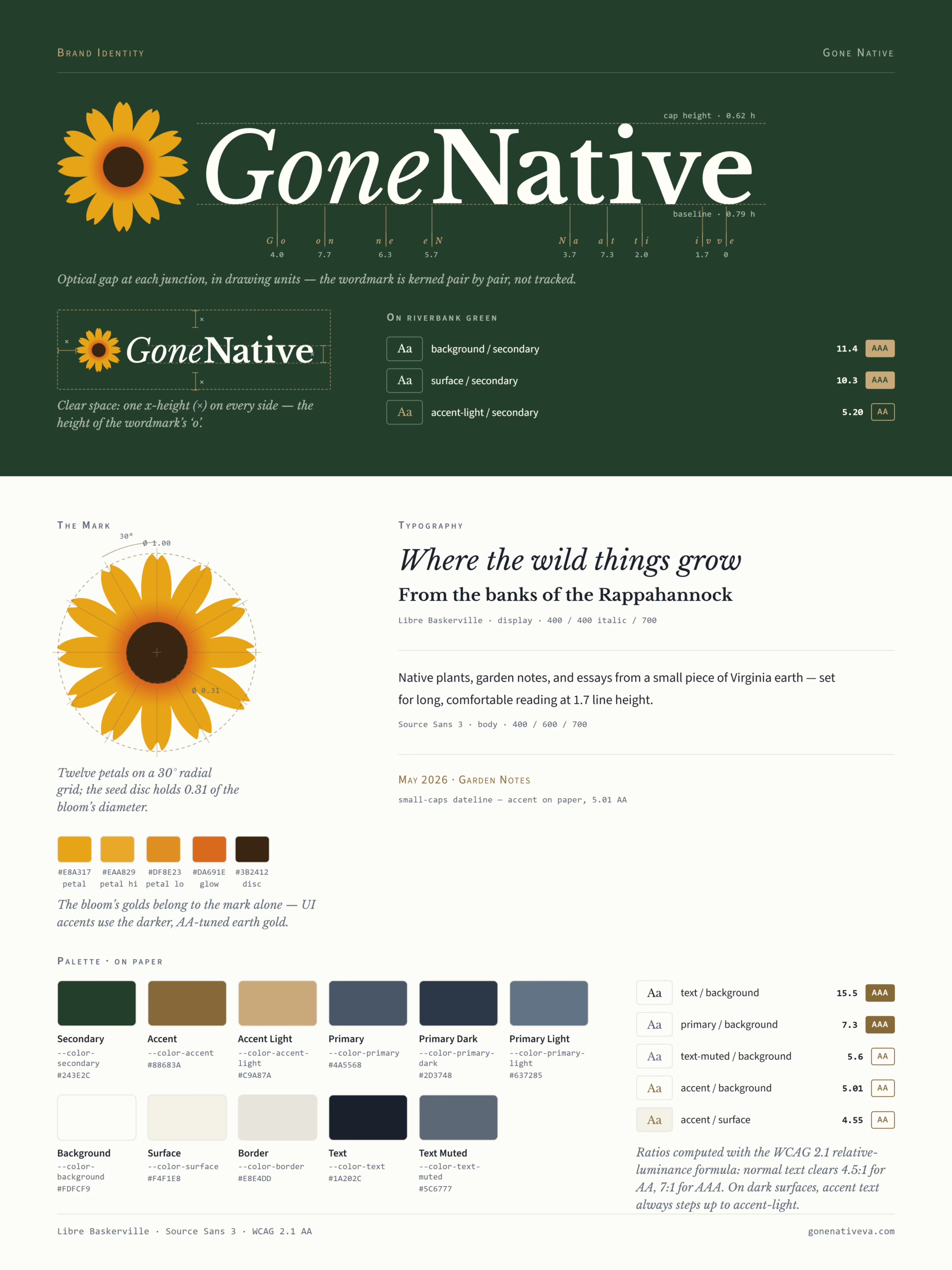
The research drove every identity decision. Where competitors went light, Gone Native went deeper: a darker, earthy palette that keeps green, restrained editorial type instead of cursive, and in place of decorative flowers a scientific drawing of an alumroot anchoring the hero. The wordmark is kerned per pair; every color token meets WCAG AA. The full design language lives in Storybook with ~170 components across ~74 stories. The single source of truth for the build.
3. Directing AI as a Force Multiplier
I built the production site myself, directing AI-assisted development with Claude Code. AI didn’t design the product, I did. I defined the architecture, design system, and quality gates, then encoded them as enforced rules: token-only styling, story-first components, and strict conventions checked on every change. The result is one person shipping at a scope and quality that used to require a team, without surrendering a single design decision.
4. Two Audiences, Two Testing Tracks
The site has two users: Ruth, who runs it, and the public, who reads it. So, I designed and tested each on its own track.
For the owner: I built the CMS around Ruth, not everyone. The admin menu mirrors the site’s own page order; in testing she noted she always knew where to go, unlike WordPress. Forms are action-driven (Save, Schedule, Publish as buttons), drafts autosave, versions roll back, and changes preview before going live. Her sessions reshaped the design. I merged viewing and editing into one page editor after she kept landing on the wrong screen, and added tasteful auto-truncation with tap/hover reveal for long titles while screen readers get the full text.
For the public: in-person testing with local and regional gardeners drove changes. Resource cards weren’t reading as interactive on mobile, so I added external-link icons; participants wanted to know where to buy native Virginia plants, which became a new resources section; and overlong page intros got trimmed. What didn’t need fixing mattered too. Everyone quickly grasped what the site was about, confirming the brand and copy were doing their job.
5. Measuring What Matters
The site launched instrumented for editorial questions, not just pageviews: 19 custom behavioral events: read completion, scroll depth, CTA clicks, form abandonment, sharing, and AI-search referrals. They feed an at-a-glance admin dashboard with a deeper Looker Studio report behind it, captured server-side so ad blockers can’t blind the numbers. From day one, Ruth sees not just who visited, but who read to the end.
Results
Perfect Scores, Verified
Google PageSpeed: 100 in accessibility, best practices, and SEO, with 90+ mobile and 98–100 desktop performance — on a content-rich, fully accessible site.
An Independent Publisher
Ruth writes, schedules, publishes, and manages events, media, and comments entirely on her own — "a joy to have such a detailed site that's easy to update."
Insight from Day One
Nineteen behavioral events, an owner dashboard, and a Looker Studio report inform every content decision with real reader behavior — even AI-search traffic.
Built to Last, Not to Bill
No plugins to patch, no monthly care-plan tax, and nightly automated backups with safe one-button restore. Quality that compounds instead of decaying.